
Transformation Is a Talent Strategy: What It Should Look Like for Small, Medium and Large South African Employers
In many businesses, transformation is still brought into the HR conversation too late.
It comes up when reporting deadlines approach. When leadership reviews representation data. When a key hire raises difficult questions about pipeline, readiness, or succession. By then, the conversation is often reactive.
That is the wrong starting point.
Transformation works best when it is treated as a talent strategy: something built into how a business hires, develops, promotes, and retains people over time. Not a side project. Not a compliance scramble. Not a once-a-year exercise in optics.
In the South African context, that matters even more. Race cannot be treated as incidental. Our labour market has been shaped by unequal access for decades, and that history still shows up in who gets exposure, who gets sponsored, who is seen as “leadership material”, and who gets left out of high-value opportunities. But a strong transformation strategy is not about tokenism or panic hiring. It is about widening access, building capability, and making better long-term decisions about talent.
That is where a more strategic approach matters. Employers that treat transformation as part of a broader talent strategy are far more likely to build teams that are both more representative and more resilient.
The shift business leaders need to make
Many organisations still separate transformation from hiring quality, succession planning, or retention. In practice, that creates a problem.
A business may say it wants more representative leadership, but still recruit through the same narrow networks. It may invest in early-career talent, but fail to support those employees once they enter the business. It may talk about inclusion, but leave line managers unequipped to lead diverse teams well.
That is why transformation should be viewed through a much more practical lens.
The real question is not whether transformation matters. The real question is whether your current talent model enables transformation.
That means asking tougher questions:
- Are we widening access to the right talent pools?
- Are we building capability early enough?
- Are we creating real pathways into specialist and leadership roles?
- Are we retaining strong people while change takes place?
- And are we treating transformation as a business capability issue, rather than a reporting issue?
When employers ask those questions honestly, the gaps become easier to see. And importantly, they become easier to address.
What a transformation talent strategy includes
A transformation talent strategy is not one initiative. It is a connected set of decisions about workforce shape, opportunity, and future capability.
At its strongest, it includes:
- broader access to talent
- fair and consistent hiring practices
- visible development pathways
- better manager capability
- succession planning that does not rely on last-minute external hiring
- retention practices that keep strong people engaged during change
This is where many employers need a reset. Transformation is often discussed as though it sits in tension with business performance. In reality, the opposite is usually true. A business that widens access intelligently, builds stronger feeder pipelines, and develops overlooked talent well is usually building a stronger organisation overall.
That is also why RAG Talent’s employer solutions are positioned around future-ready talent pipelines, stronger retention, and measurable business outcomes — not just vacancy filling.
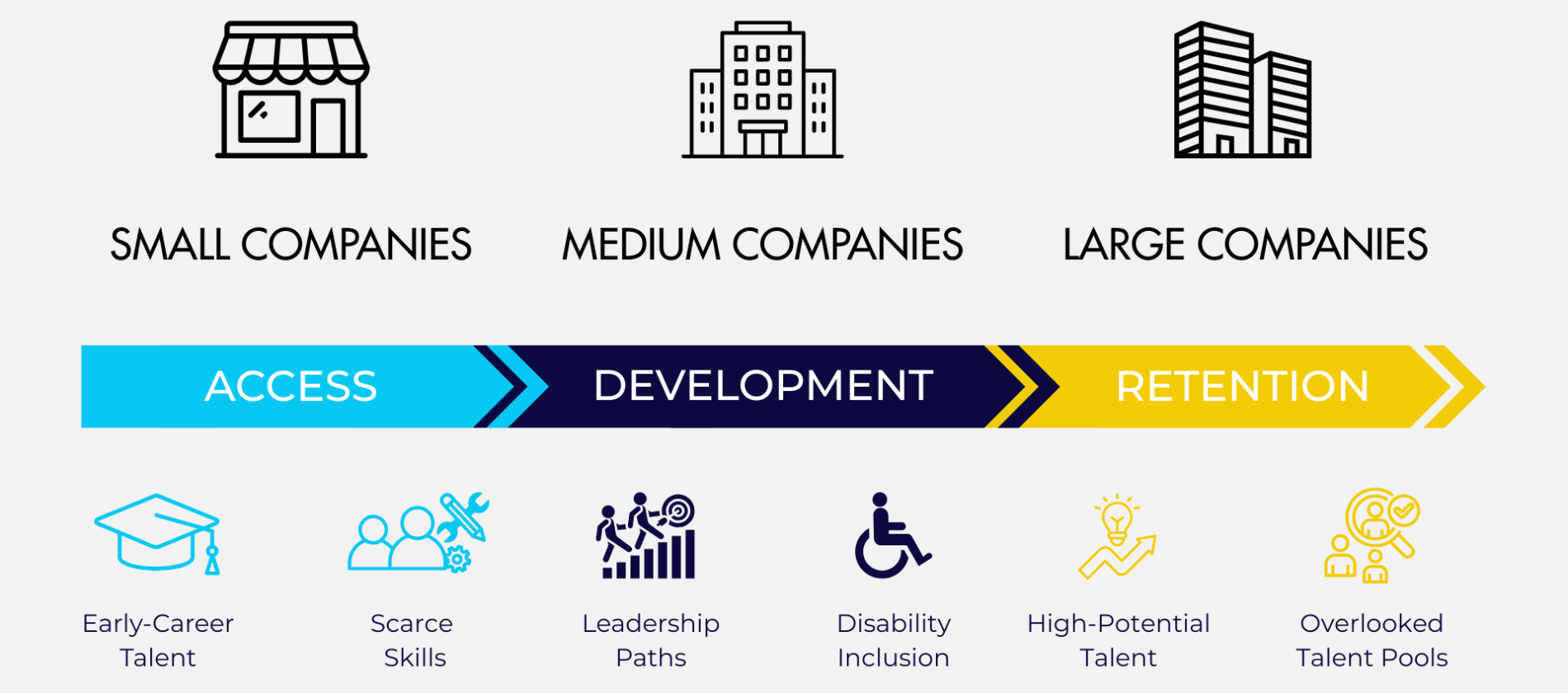
What this looks like for small companies
For smaller employers, transformation should be simple, deliberate, and built into hiring habits from the start.
Small businesses often assume transformation becomes relevant only once they cross a certain headcount threshold. Strategically, that is a mistake. The earliest hires in a business shape the culture, set management expectations, and build the future leadership pipeline. If those hires all come from the same networks, same backgrounds, or same version of “fit”, the business narrows itself long before it notices the consequences.
For small companies, a smart transformation strategy usually means:
- widening sourcing channels early
- using structured interviews instead of instinct-led selection
- tracking basic diversity and representation trends
- creating entry points for emerging talent
- making fairness part of manager behaviour from day one
This is also where graduate and early-career talent pipelines become commercially valuable. They are not only a social good. They are among the most effective ways to build future capability before skills gaps become costly.
Small companies do not need a heavy process. They need better hiring habits.
What a transformation strategy looks like for medium-sized companies
Medium-sized employers often reach the point where transformation can no longer sit quietly in the background.
By this stage, the business usually has enough structure for patterns to become visible. Promotion decisions start to shape management layers. Skills gaps become more expensive. Leadership succession starts to matter more. And if transformation has not been planned, the business can find itself under pressure with too little pipeline to support its goals.
This is where transformation needs to become more intentional.
For medium-sized companies, the focus should shift to:
- understanding workforce composition by level and function
- identifying bottlenecks in promotion and progression
- strengthening feeder pools into specialist and management roles
- connecting recruitment strategy to long-term representation goals
- building manager accountability for both inclusion and performance
This is also the point where employers need to look beyond hiring numbers and ask whether their talent pipeline is genuinely supporting the future shape of the organisation.
Many are surprised to discover that their biggest risk is not an external talent shortage. It is an internal leakage. They hire diverse talent into the business, but lose people before that talent reaches influence.
What a transformation strategy looks like for large companies
Large employers need a transformation strategy that operates at the system level.
At this scale, the issue is rarely whether the business cares. The issue is whether the business has built transformation into the machinery of how talent moves. That includes leadership development, pay equity, internal mobility, succession planning, development opportunities, and executive accountability.
Large organisations cannot rely on isolated interventions. They need a joined-up model.
That usually includes:
- executive ownership of transformation outcomes
- workforce planning is linked to representation and business growth
- targeted development for underrepresented talent
- stronger succession planning for critical roles
- inclusive leadership capability across business units
- retention strategies that protect both continuity and trust
This is where transformation shifts from recruitment campaigns to system design.
The strongest large employers do not wait for external hiring to solve every gap. They build internal movement, internal visibility, and internal readiness. They understand that if the pathway to leadership remains narrow, external appointments alone will never solve the structural issue.
The categories of talent that should form part of a transformation strategy
One of the biggest mistakes employers make is focusing only on senior appointments.
That approach is expensive, competitive, and rarely sustainable on its own.
A stronger transformation strategy includes multiple categories of talent, each playing a different role in shaping the future organisation.
1. Early-career talent
This includes graduates, interns, learnership candidates, apprentices, TVET graduates, and first-job professionals.
This group matters because it expands access early and creates the foundation for future specialist and leadership capabilities. Employers that invest here consistently are usually less dependent on reactive hiring later.
This is why building diverse early-career talent pipelines is one of the smartest long-term transformation moves a business can make.
2. Mid-career talent in hard-to-fill roles
These are professionals in technical, digital, engineering, operational, commercial, and high-demand specialist roles.
Transformation strategies often weaken when employers ignore the reality of scarce skills. Representation matters, but so does capability. The answer is not to lower standards. It is to widen access, improve sourcing, and create clearer development pathways for mid-career talent who can grow into critical roles.
3. Women in leadership and specialist pathways
Many organisations have improved gender representation in some areas, while still falling short in revenue-generating, technical, operational, or senior decision-making roles.
That gap matters. A healthy transformation strategy looks not only at who is in the business, but where influence sits.
4. Persons with disabilities
Disability inclusion should never be treated as a symbolic add-on. It should form part of a broader inclusion strategy that includes reasonable accommodation, role design, manager awareness, and access to progression.
How best to hire neurodivergent graduate talent
5. Internal high-potential talent
Some of the best transformation opportunities already exist inside the business.
Internal high-potential employees often need better visibility, sponsorship, stretch opportunities, and clearer development routes. Employers that overlook internal talent often create unnecessary external dependency while losing capable people who could have grown into the roles they are trying to fill.
6. Overlooked and non-traditional talent pools
This may include talent from township and rural communities, career returners, TVET-trained candidates, and neurodivergent professionals whose strengths are often missed by conventional hiring approaches.
For employers willing to rethink access, this can be one of the most valuable parts of a modern talent strategy. Inclusive recruitment strategies do not weaken standards. They often improve them by helping employers identify capability more accurately.
How to hold onto good skills while transformation takes place
This is where many leadership teams become uneasy.
They worry that transformation may unsettle existing employees, create defensiveness, or increase attrition among strong performers. Those risks are real if change is handled badly. But they are not inevitable.
The answer is not to slow the transformation, the answer is to lead it properly.
Employers hold onto good skills during change when they create clarity, fairness, and trust.
That means:
Keep performance standards clear
Employees are more likely to stay when expectations are transparent and role-based. Good people do not usually leave because a business is changing. They leave when change feels arbitrary, opaque, or poorly managed.
Invest in line managers
Managers shape the lived experience of transformation more than policy documents do. If line managers cannot run fair processes, give balanced feedback, and lead mixed teams confidently, both retention and transformation will suffer.
Create visible growth paths
People stay when they can see a future. That applies to existing employees and emerging talent alike. Development pathways, stretch roles, sponsorship, and clear progression frameworks all reduce unnecessary talent loss.
Communicate with care
In South Africa, language matters. Transformation should not be framed as a zero-sum exercise where one group’s advancement automatically signals another group’s exclusion. The strongest messaging is honest and steady: the business is broadening access, strengthening representation, and building a more sustainable talent model over time.
Protect dignity while broadening opportunity
This is especially important during organisational change. Existing employees need to feel respected, fairly assessed, and clearly informed. Future talent needs to feel welcomed, supported, and set up to succeed. Strong leadership can hold both realities at once.
A better South African conversation
Transformation should not be reduced to slogans, defensiveness, or compliance language alone. It should be approached with realism, respect, and strategic rigour.
That means acknowledging the role race has played in shaping access and opportunity, while also recognising that sustainable change depends on better talent systems, not symbolic moves. It means understanding that representation matters, but so do capability, continuity, and trust. And it means recognising that businesses do not build strong teams by choosing between performance and transformation. They build strong teams by designing for both.
That is where the real opportunity lies.
Not in doing the minimum.
Not in saying the right things.
But in building a broader, stronger, and better-prepared workforce.
Final thought
The most effective transformation strategies are rarely tick-box exercises.
They are built through better hiring decisions, broader access, stronger development, more confident managers, and clearer pathways into leadership.
Transformation is not a side conversation. It is a talent strategy conversation.
And the businesses that treat it that way will be far better positioned to grow. Talk to us, RAG Talent focuses on assisting companies with transformation talent pipelines.